Let’s be real: the world of social media feels less like a platform for connection and more like a content conveyor belt running at warp speed. Every minute, millions of posts, videos, and threads are dumped onto the timeline. It’s no longer enough to just post consistently, or even to post great visuals; you need to cut through the noise, grab the user’s attention in the first three seconds, and spark a genuine, often immediate, reaction. The ultimate goal isn’t just passive visibility; it’s engagement. Likes, comments, shares, and saves are the true metrics that algorithms reward and that drive organic reach.
The challenge is simple: how do you maintain a consistent, high-volume presence across multiple platforms while keeping every piece of content unique, fresh, and conversation-starting? The human bandwidth required to execute this strategy is often unsustainable for even large teams.
Enter ChatGPT. This isn’t just a fancy word processor or a simple chatbot; it’s a powerful Large Language Model (LLM) that has been trained on a colossal amount of human-generated data. It can process massive amounts of information, understand nuanced human language, and generate highly creative, context-specific outputs faster than any human team. For social media managers and strategists, integrating ChatGPT effectively isn’t about replacing the human touch; it’s about building a sophisticated co-pilot that handles the heavy, repetitive, and time-intensive lifting of ideation and drafting. This frees up the human team to focus their energy on high-level strategy, creative direction, and, most importantly, authentic community building.
This guide is your deep dive into the effective, non-robotic integration of ChatGPT across your entire social media lifecycle. We’re talking strategic planning, hyper-personalized content creation, real-time community management, and performance analysis. This is the definitive playbook for leveraging AI to achieve engagement that feels utterly authentic, genuinely human, and totally viral-ready.
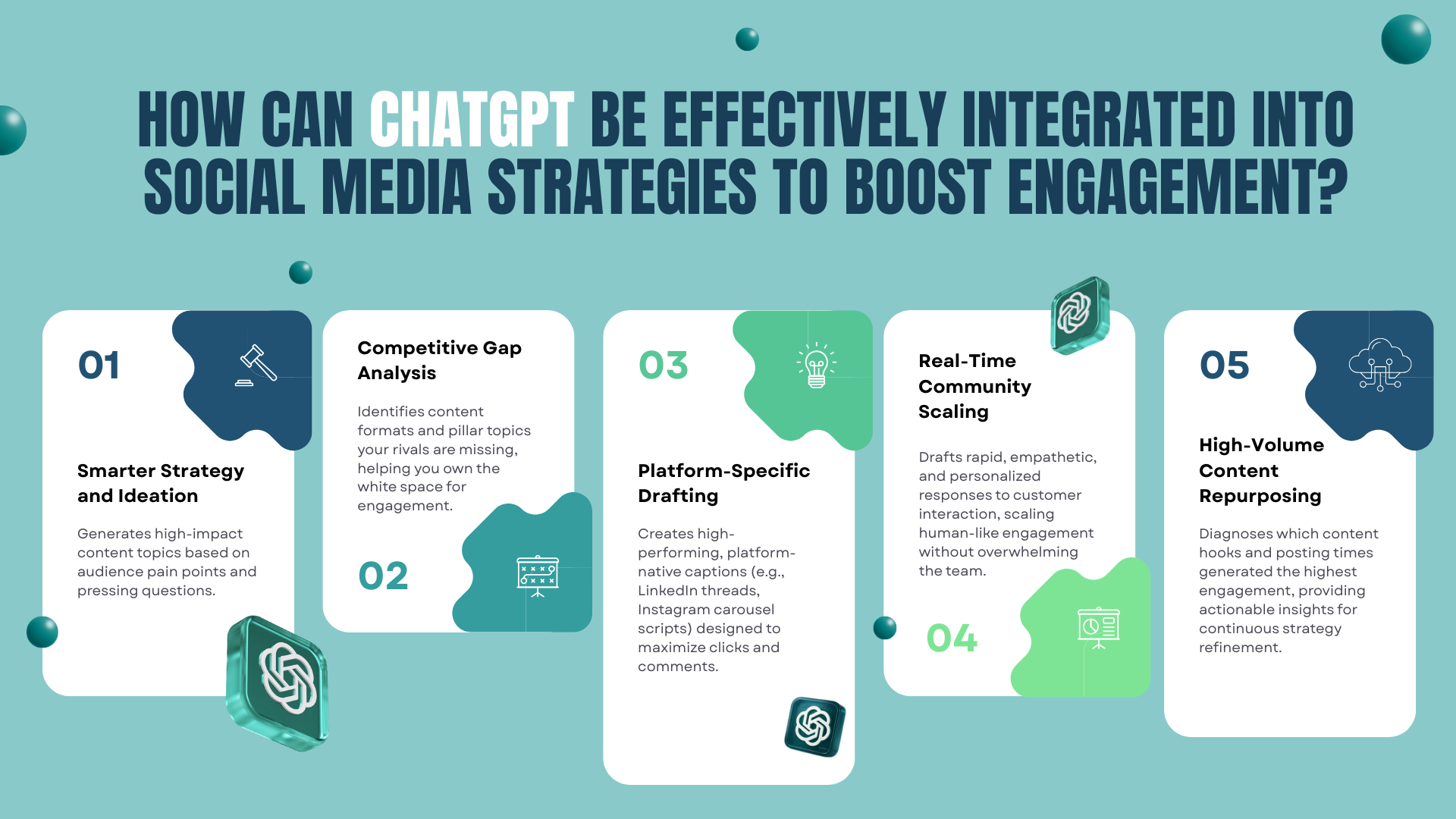
Strategy and Ideation (The Brainstorm Amplifier)
Using LLMs for Smarter Content Planning
The most impactful use of ChatGPT, and the one that separates the pros from the novices, isn’t writing a quick caption. It’s using the model as a sophisticated analyst and ideation partner to structure a strategy that actually drives measurable engagement and aligns with user needs. If the idea is weak, the content will fail, regardless of how well the AI writes the copy.
Audience and Persona Deep Dive: Beyond Demographics
A generic audience profile leads to generic content. Use the model to dig deeper into the psychographics of your followers:
- Pain Point Mapping: Instead of relying on gut feelings, feed ChatGPT your existing customer touchpoints—this could be anonymized support ticket transcripts, snippets from product reviews, comments from previous posts, or external forum discussions. Prompt the model to: “Analyze this qualitative data and generate a list of the top 10 most pressing, unspoken emotional pain points for our target audience, [Audience Description], framed as questions we can answer in a content series.” This immediately flips your content focus from being brand-centric to being relentlessly user-problem-solving.
- Persona Refinement: Ask ChatGPT to act as a “Psychographic Analyst” to develop detailed, emotionally resonant user personas. Include not just their age and location, but their social media habits (e.g., “They spend 40 percent of their time on TikTok looking for life hacks”), their preferred platform tone (e.g., “Responds best to empathetic, visually rich content”), and the type of content they save versus the content they only like. This ensures your engagement attempts are hyper-targeted to actions that signal deep interest.
Trend and Competitor Analysis: Finding the White Space
Engagement often comes from being timely or being unique. ChatGPT can quickly filter the noise to find the next move:
- Competitive Gap Finding: Provide ChatGPT with the URLs or content snippets from your top 3 primary competitors. Prompt it to: “Identify the top three performing content formats (e.g., carousel, short-form video, poll) for these competitors based on their recent activity. Then, suggest three unique, high-potential content pillars that they are currently ignoring. Frame the suggestion for a platform-specific strategy (e.g., a LinkedIn thread series that contrasts their existing content).” This immediately gives you content angles your rivals aren’t hitting, increasing your chances of finding new audience segments.
- Algorithm Trend Spotting: Use the model to quickly summarize current social media algorithm priorities and suggest content formats that align with those priorities. For example: “Based on public knowledge of the latest algorithm shifts, suggest 5 Instagram Reel formats that maximize ‘Watch Time’ and ‘Re-shares’ for a brand in the [Industry] niche.”
Content Pillar Structuring: Organized Creativity
- Pillar and Sub-Topic Generation: Ask the model to generate a set of core content pillars (e.g., Educational, Entertaining, Community-Driven, Promotional, Thought Leadership) and then, for each pillar, generate 15-20 highly specific sub-topics tailored to a specific platform’s native features. This ensures your content isn’t just generic—it’s optimized for the container (e.g., asking for unique Reddit-style thread ideas versus Instagram story prompts).
- Engagement Matrix Creation: Ask ChatGPT to create a calendar structure where it plots out content types based on engagement goals. Example prompt: “Create a 4-week calendar skeleton where Monday focuses on ‘Comment Generation’ (e.g., polarizing question posts), Wednesday focuses on ‘Save Generation’ (e.g., educational guides), and Friday focuses on ‘Share Generation’ (e.g., humorous weekend content).”
Content Creation and Personalization (Scaling the Creative Flow)
From Draft to Engagement Hook in Seconds
This is where ChatGPT begins to save your team countless hours, transforming high-level strategic ideas into engaging, platform-optimized drafts. The critical component is to infuse the AI’s output with a distinctive, human-driven brand voice to maintain authenticity.
Mastering the Prompt Engineering: The Triple Threat
The difference between a generic, AI-generated caption and an engaging, on-brand masterpiece lies entirely in the prompt structure. To avoid generic, robotic text, every creation prompt must include:
- Role/Expertise: Instruct the model to adopt a professional persona. “Act as a witty, Gen Z-focused TikTok copywriter for a SaaS brand.”
- Brand Voice/Tone: Specify the emotion and style. “The tone must be conversational, empathetic, slightly sarcastic, and use internal industry jargon naturally.”
- Engagement Goal/Constraint: Define the desired user action. “Keep the output to three concise paragraphs, using three relevant emojis, and maximizing space for a strong Call-to-Action (CTA) that encourages sharing.”
- The Crucial Ask: Don’t just ask for a caption. Ask for a “high-performing caption that uses a curiosity gap hook in the first sentence, provides one actionable insight in the body, and ends with a specific question to drive comments.” This forces the AI to prioritize engagement tactics.
Platform-Specific Optimization: Honoring the Medium
Content must feel native to the platform to succeed. ChatGPT is excellent at adapting tone and structure when given precise constraints:
- LinkedIn Focus: Thought Leadership, Discussion, Authority. Prompt task: Generate a 5-point, evidence-backed thought thread on [Topic] that uses a controversial opening sentence and encourages peer debate in the comments. Structure it for high readability (single sentences, ample white space).
- Instagram Focus: Saves, Shares, Visual Storytelling. Prompt task: Draft three distinct captions for this carousel post about [Product Feature]. One should use a listicle format for saves, one should tell a mini-story for connection, and one should ask a ‘Would you rather’ poll question for comments.
- TikTok/Reels Focus: Watch Time, Trending Audio Adaptation. Prompt task: Write a 60-second video script outline for a ‘Day in the Life’ series focused on [Target Audience]. Include a specific audio cue, suggest three high-retention on-screen text overlays, and provide a hook to maximize viewer retention past the 3-second mark.
- X (Twitter) Focus: Virality, Real-Time Response, Concise. Prompt task: Create 10 witty, 280-character tweets responding to the current trending topic [Topic]. Focus on humor and brand relevance, ensuring the CTA drives engagement back to a thread or landing page.
Content Repurposing and Variation: Efficiency Multiplier
- The Content Multiplier: Use a single piece of long-form content (a blog post, an industry whitepaper, a client case study) as the source material. Prompt ChatGPT to: “Repurpose this 1500-word blog post into a 7-slide Instagram carousel script, a 2-minute YouTube short outline, and 5 distinct LinkedIn polls. Ensure the core message remains consistent and provide a unique CTA for each format.” This generates vast, consistent content volume while maintaining message integrity.
- A/B Testing Copy: Ask the model to create three distinct variations of the same promotional copy (e.g., one focusing on FOMO, one on Value/ROI, and one on Social Proof/Testimonial) for A/B testing on ad platforms. This allows for data-driven optimization of your ad spend.
Real-Time Community Management (Scaling the Human Touch)
Using AI for Prompt, Personalized Interaction
Engagement is fundamentally a two-way street. Prompt, personalized, and thoughtful responses are crucial for building community and driving further interaction, but a high volume of comments and direct messages (DMs) can quickly overwhelm a human team. ChatGPT excels at scaling this conversational layer without sounding like a detached bot.
Automated, On-Brand Response Drafting
- The Brand Voice Template (Custom Instructions): The first step in effective response automation is providing ChatGPT with a comprehensive guide to your brand’s conversational tone, including examples of past positive and negative replies. Set the custom instructions to: “Always respond with an empathetic, casual, and solution-focused tone. Never use generic phrases like ‘We appreciate your comment.’ Use the customer’s name if provided and keep the response brief but informative.”
- The Negative Feedback Handler: This is where AI saves brand reputation. Use ChatGPT to draft diplomatic, empathetic replies to negative comments or complaints. Prompt it to: “Draft a response to this negative comment [Insert Comment]. Acknowledge their frustration, apologize sincerely, and provide a clear next step for resolution (e.g., ‘Please DM us your order number so we can investigate and fix this immediately’).” This speed and clarity can defuse tension and demonstrate accountability.
Personalized Engagement at Scale
- Comment Categorization and Personalization: Feed ChatGPT a batch of 50 recent comments and ask it to: “Categorize these comments into buckets: ‘Praise/Compliment,’ ‘Inquiry/Question,’ ‘Constructive Feedback,’ and ‘Off-Topic Spam.’ For the ‘Praise/Compliment’ category, generate 5 unique, personalized responses that reference a specific detail from the original post (e.g., mention the color of the product they liked).” This moves beyond “Thanks!” to responses that feel specific and thoughtful.
- Idea Generation from Interaction: Use comments and DMs as real-time fuel. Prompt ChatGPT to: “Analyze the questions asked in the last 20 DMs and generate a 60-second video script idea that answers the most common question in an entertaining, visual format.” This turns engagement data into highly relevant future content, closing the loop.
Interactive Content Development
- Quiz and Poll Generation: Interactive content like quizzes, polls, and prediction boxes are high-engagement accelerators. Ask ChatGPT to: “Generate 10 multiple-choice poll questions about [Niche Topic] for Instagram Stories. The questions should be quick to answer but provoke curiosity about the answer, leading to the user clicking the next story.”
- Challenge and Prompt Creation: Develop User-Generated Content (UGC) campaigns by prompting ChatGPT to: “Create a fun, low-barrier-to-entry UGC challenge for our community focused on [Product/Service Benefit]. Give it a catchy title, clear submission guidelines, and 5 example posts from different audience types.”
Measurement and Iteration (The Data Loop)
AI-Driven Performance Analysis for Continuous Growth
Social media strategy is only as good as its ability to learn and adapt. ChatGPT is a phenomenal tool for turning raw, often overwhelming, analytics data into crisp, actionable insights for engagement optimization. This capability is key to escaping the “post-and-pray” cycle.
Transforming Raw Data into Insights
- Performance Summarization: Instead of spending hours building manual reports, feed ChatGPT your weekly or monthly social media analytics data (e.g., CSV files of impressions, reach, likes, comments, shares, and save rates). Prompt it to: “Analyze this data for the last 30 days. Identify the top 5 performing posts and explain in three bullet points why they outperformed the others, focusing on content type, posting time, and the CTA used. Also, identify the bottom 5 and suggest a single, immediate fix for each.”
- Engagement Rate Diagnostics: Ask the model to calculate the engagement rate (ER) for specific content clusters and suggest targeted improvements. Prompt: “Our average ER on educational carousels is 2.1 percent, but on humorous short-form videos, it’s 5.8 percent. Suggest three strategic moves we can make to boost the ER of the carousels without sacrificing the educational value. Focus on changes to the first slide hook.”
Identifying Optimization Opportunities
- Hashtag Strategy Refinement: Feed ChatGPT a list of your top 10 performing posts and the hashtags used. Ask it to: “Analyze these hashtags for relevance and performance. Identify 5 high-volume, relevant hashtags we are missing and 5 low-volume, niche hashtags we should start using to boost discoverability within a specific community.”
- Optimal Posting Time Analysis: Based on your performance data, ask the model to recommend a new posting schedule for a specific platform. Prompt: “Based on the recorded interaction times, recommend a new 7-day posting schedule for Facebook that aims to capture peak lunchtime and late-evening engagement for our specific audience, justifying the suggested times with data points.”
Predictive Content Modeling: The Feedback Loop
- Predictive Hook Generation: Use the insights from your top-performing content clusters (Pillar 4) and feed them directly back into the content creation process (Pillar 2). For example, if analysis showed that all top posts used a “Personal Experience Hook,” prompt: “Based on the finding that our top-performing posts used a ‘Personal Experience Hook,’ generate 10 new, unique personal story hooks for our next product launch announcement.” This creates a powerful, data-driven, and continuously improving content feedback loop.
Conclusion: Co-Pilot, Not Autopilot
Integrating ChatGPT into your social media strategy is less about automation and significantly more about amplification. It’s the sophisticated co-pilot that helps you fly farther, cover more ground, and respond faster than ever before. The AI excels at speed, scale, and pattern recognition; it can generate 50 unique caption drafts or dissect a month of data in the time it takes a human to write one perfect caption.
However, the core of engagement—the authentic brand voice, the genuine empathy in a customer service response, the strategic choice of which cultural trend to jump on, and the ultimate creative approval of content—must remain human. Over-reliance on AI without a final human editing layer leads to a sterile, generic, uncanny-valley-style feed that algorithms eventually punish and users quickly learn to ignore. Genericity is the antithesis of engagement.
The winning formula in the new digital landscape is a disciplined blend: use ChatGPT for the strategic, high-volume heavy lifting (ideation, competitor analysis, drafting, scaling thoughtful responses) and reserve your human team’s energy for the creative flair, relationship building, ethical oversight, and injecting the unique personality that only a human can provide. Get the synergy right, and you won’t just keep up with the algorithm; you’ll finally have the bandwidth to build the active, thriving community your brand deserves.
FAQs: ChatGPT and Social Engagement
Q: Will ChatGPT replace my social media manager?
A: Absolutely not. ChatGPT is a tool for super-scaling efficiency, not for replacing human strategy. It lacks lived experience, emotional intelligence, brand identity, and ethical judgment. A great social media manager will evolve into an AI-augmented strategist—they will use ChatGPT to complete tasks in 10 minutes that used to take 10 hours, freeing them up to focus on high-impact human activities like genuine relationship building, creative concept development, and strategic partner outreach.
Q: How do I make sure the AI content doesn’t sound robotic?
A: The key is in the complexity of your prompt. You must provide a highly specific Brand Voice Guide to the model. Instruct it on the required tone (“witty, casual, empathetic, never corporate”), specific slang to use or avoid, and provide 3-5 examples of high-performing human-written content. You must also commit to a human editing layer to review, refine, and inject unique brand personality before posting.
Q: Can I use ChatGPT to write content for all platforms?
A: Yes, but only if you ask it to adapt the content specifically for each platform’s native constraints and audience expectations. A 5-point LinkedIn thread requires a completely different structure (professional, data-driven, structured text) than a short, punchy, meme-ready Instagram caption (visual hook, urgent CTA). Always specify the platform in the prompt.
Q: Should I use AI for sensitive customer service DMs?
A: Use it to draft a starting point. For sensitive, high-stakes, or highly complex complaints, use ChatGPT to generate the first draft of an empathetic, legally compliant response that clearly outlines the next steps for resolution. The final review, personalization, and send-off must be done by a human to ensure genuine empathy and accountability, which protects your brand reputation.
Q: What is the biggest mistake brands make with ChatGPT?
A: Over-automation and Under-prompting. Brands often use generic prompts (“Write a post about my new product”) and then auto-schedule the resulting generic copy without review. This leads to a dull, low-engagement feed that looks and sounds like it was written by a machine. Always aim for specific, engaging output and treat the AI draft as a starting point, never the final product.

Gourav Jaswal is a digital marketing strategist and SEO expert with over 14+ years of experience in search engine optimization, local SEO, PPC advertising, and online business growth. As the founder of SEO & Web Service, he has helped businesses improve their online visibility, generate qualified leads, and achieve sustainable growth through data-driven digital marketing strategies. Over the years, he has worked with 90% USA-based clients across a wide range of industries, developing and executing successful SEO campaigns for multiple niches with proven track records. Gourav specializes in SEO audits, Google Ads, content marketing, technical SEO, local SEO, and website optimization, helping businesses strengthen their online presence, increase organic traffic, and drive measurable business results.