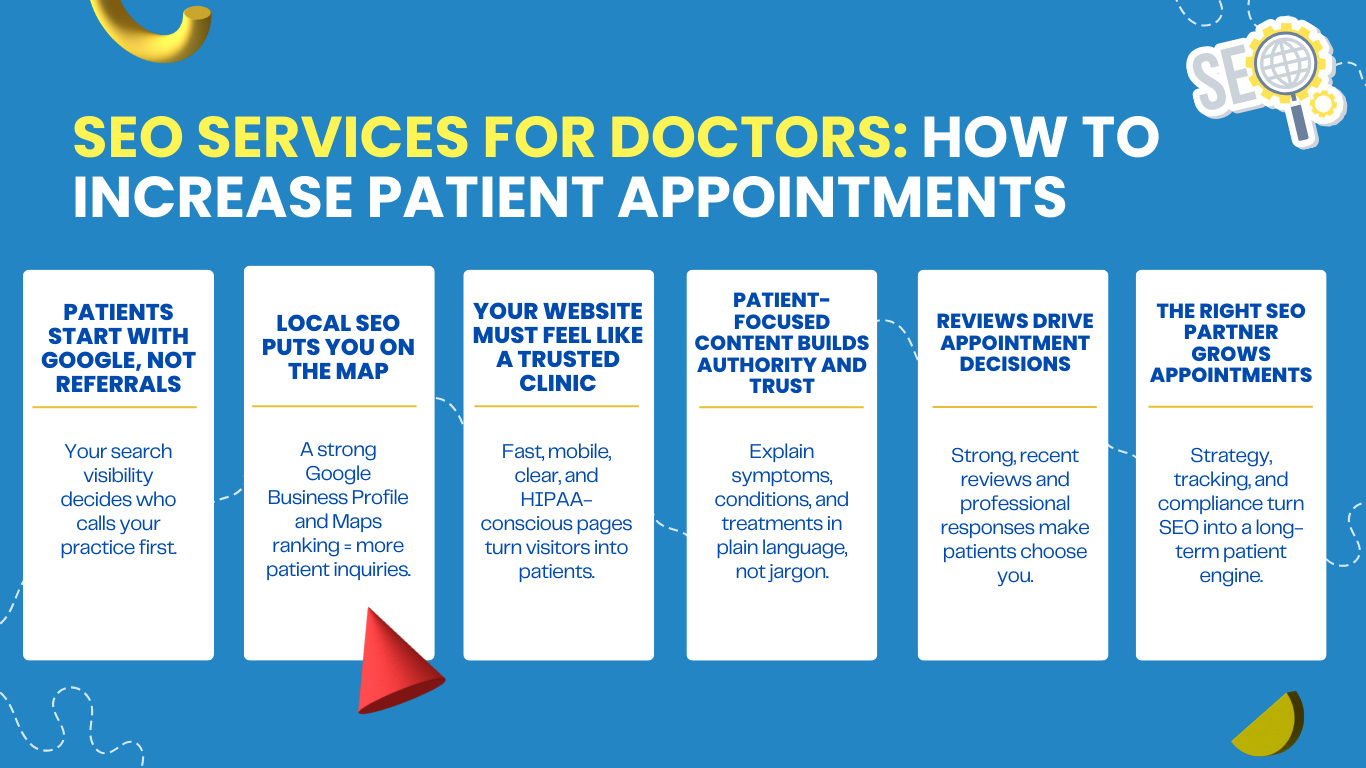
The way patients choose healthcare providers has completely transformed. A decade ago, most patients relied on referrals, word of mouth, or proximity. Today, nearly every patient journey begins online. People research symptoms, explore possible conditions, compare treatments, and review local providers long before they decide to call a doctor. This makes search visibility one of the most influential factors in growing a medical practice.
Patients do not wait for recommendations anymore. They search for answers. They judge credibility based on online presence. Before they ever meet you, they evaluate your practice through Google results, reviews, website quality, and how clearly you explain treatments or conditions. In many ways, Google has become the new front desk. Your online presence either invites a patient in or sends them to another provider.
SEO is not an extra marketing service for doctors. It is a long-term patient acquisition system. When done correctly, SEO can consistently bring new patients every month, reduce reliance on paid ads, and establish your practice as an authority in your specialty. It creates compounding visibility over time. The more people discover you, the more patients trust you, and the more appointments get booked. For modern medical practices, SEO is not a luxury. It is the foundation of sustainable growth.
How Today’s Patients Actually Search for Doctors
Understanding how patients behave online is the starting point for effective medical SEO. Healthcare search behavior is unique. Patients search with urgency, fear, confusion, and a desire for clarity. They want fast answers from a provider they can trust.
Mobile dominates medical-related searches. Patients research conditions and symptoms while commuting, waiting in line, or lying awake at night worrying about something they felt or noticed. This means your website must load instantly and present information clearly. Slow websites lose patients within seconds.
Insurance plays a major role in decision-making. Many patients search specifically for providers who accept their insurance. Queries like dermatologist near me Blue Cross or pediatric dentist accepting Cigna are increasingly common. If your website and Google Business Profile do not include your insurance list, you lose a large number of potential appointments.
Symptom-based searching also drives provider choice. A patient might begin by searching for a persistent headache behind the eyes, notice suggestions for sinus issues or migraines, then search migraine specialist near me. A practice with strong content will capture patients at both stages of this journey.
Patients also evaluate a set of trust signals before contacting a doctor. These include reviews, credentials, photos of your office, available appointment slots, staff friendliness, and whether your website feels professional. Speed and clarity heavily influence appointment decisions. If a patient cannot quickly understand what you treat, what you offer, and how to book, they will choose another provider.
Local SEO Is the Powerhouse Behind Medical Practice Growth
Local SEO, specifically Google Maps and the Local 3 Pack, determines who gets the most patient calls. When someone searches for a service like urgent care or family doctor near me, they rarely scroll past the map results. The top three practices receive the vast majority of clicks, direction requests, and phone calls.
Google Maps rankings depend on proximity, relevance, and prominence. Doctors cannot control proximity, but they can strongly influence relevance and prominence. This includes optimizing categories, adding accurate service lists, posting updates, maintaining strong reviews, and including consistent business information across the web.
The Local 3 Pack matters even more than traditional website rankings for doctors. When someone searches for a dentist in their neighborhood, they almost always choose one of the top map results. These listings show photos, star ratings, hours of operation, insurance details, and direct call buttons. They also feel trustworthy because Google highlights them prominently.
An optimized profile converts browsing patients into booked appointments. When potential patients see complete information, updated photos, strong reviews, and clear descriptions, they feel confident reaching out. Local SEO is the fastest path for a doctor to increase patient volume.
The Website Foundations Every Doctor Must Have
A medical website is more than a digital brochure. It is an extension of your clinical professionalism. Patients judge the quality of your care by the quality of your website.
Your site must be HIPAA-conscious. That means secure hosting, SSL encryption, and safe handling of form submissions. You do not need patient portals on the site, but your forms and tracking must be compliant. Trust begins with privacy.
Speed and mobile responsiveness are non-negotiable. If your website takes more than a few seconds to load on a phone, patients abandon the page. Mobile layout should be clean, with large text, simple navigation, and clearly visible contact options.
Treatment and condition pages must be detailed and easy to understand. Patients want to know what you treat, how you treat it, what symptoms indicate a problem, and what outcomes they can expect. Avoid medical jargon unless necessary. Write for real people, not textbooks.
Real doctor bios with credentials, experience, education, and professional achievements build trust immediately. Patients want to know who will care for them. Photos, certifications, affiliations, and recognitions strengthen credibility.
Appointment booking must be seamless. Display your phone number clearly, add an online appointment form, include insurance details, and provide a list of accepted plans. Patients often make decisions based on accessibility and convenience.
Building a Patient-Focused Keyword Strategy
Medical keyword strategy is different from standard SEO. Patients search based on symptoms, conditions, treatments, insurance, and location. A strong strategy addresses all five.
Treatment keywords are your highest intent terms. Examples include a root canal specialist, a bunion surgery, or an acne treatment clinic. These are appointment-ready searches.
Condition keywords capture patients earlier in their search. Someone searching for varicose vein pain or chronic shoulder stiffness is not always doctor-ready yet, but is close. Optimizing for conditions helps you appear throughout the decision process.
Symptom keywords capture the earliest stage. Searches like numbness in the left arm or sudden hair loss can lead patients to your practice with proper educational content.
Local modifiers like near me, in Manhattan, or Upper East Side add geographic relevance that dramatically improves conversion.
Insurance modifiers are crucial. Patients frequently search for providers who accept their plan. Combining treatment, plus insurance plus location produces extremely high intent combinations.
Map keywords to the patient decision funnel. Early-stage queries require educational content. Middle-stage queries need condition pages. Appointment-ready queries require strong service pages.
On-Page SEO That Helps Patients Choose You
On-page SEO for doctors must prioritize clarity, accuracy, and patient comfort. Your pages should guide users through what they need to know without overwhelming them.
Structure each page around patient questions. What is this condition? What causes it? What symptoms should I watch for. What treatment options exist? When should I see a doctor? What is the expected recovery? This makes your content more useful and more trustworthy.
Add FAQ blocks that answer specific questions patients search online. These can help your website appear in AI Overviews and featured snippets. Direct, simple answers outperform long paragraphs.
Use medical schema markup. This helps Google understand your page’s context and improves search accuracy. Schemas for physicians, medical organizations, medical conditions, and local businesses are essential.
Make pages load quickly. Use lightweight images, streamlined code, and a simple layout. A slow medical site is a barrier to care, and Google penalizes slow pages in search results.
Your on-page goal is to give patients enough clarity to choose you. Clean writing, simple layouts, and reliable information make that possible.
Local SEO for Doctors: The Work That Moves Rankings Fast
Local SEO requires consistent, detail-oriented work. Start with optimizing your Google Business Profile. This includes accurate NAP information, business categories, address, hours, insurance information, and service descriptions.
Select the correct primary and secondary categories. A cardiologist, for example, should not choose a general medical clinic category. The right category dramatically influences local ranking.
Add services and treatments to your listing. Google pulls keywords from these fields to match searches. Include variations patients might use.
Reviews are one of the strongest ranking signals. Encourage patients to leave honest reviews after their visits. Never request specific wording. Respond politely and professionally without revealing private health details.
Post updates regularly. Share office announcements, procedure explanations, doctor introductions, seasonal health tips, and events. Frequent updates show Google your practice is active.
Upload high-quality photos. Patients want to see the office, exam rooms, equipment, and the doctor. Visual transparency increases trust and appointments.
A Content Strategy Built for Patient Education and Authority
Patients rely heavily on online information before contacting a provider. A strong content strategy positions your practice as the clear authority in your field.
Answer real patient questions. Search your inbox, front desk requests, and common consultation topics. Write about these common concerns in a simple, friendly, and accurate voice.
Create condition, treatment, symptom, and procedural pages. Each should explain what the patient needs to know and link to the next logical page.
Use videos for explanations. Short videos about symptoms, treatment expectations, or doctor introductions improve engagement. Video content increases trust and helps patients feel comfortable before visiting.
Build evergreen content. Topics like flu symptoms, migraines, back pain, or preventive care stay relevant year-round. Evergreen content drives long-lasting traffic.
Always prioritize accuracy. Medical misinformation is common online. Patients trust providers who give clear, professional guidance.
E-E-A-T for Doctors: The Trust Signals AI and Google Expect
Google requires extremely high accuracy from medical websites because healthcare falls under Your Money Your Life content. This makes E E A T essential for all doctors.
Include real credentials prominently. List degrees, hospital experience, certifications, fellowships, and years in practice.
Write transparent author bios and bylines. Patients want to know who wrote the content. A medical article written by a doctor ranks higher than generic content.
Cite authoritative sources. Link to medical studies, government health agencies, or research organizations. Citations show responsibility.
Show real-world experience. Highlight case studies, patient outcomes, or years of practice. This signals reliability to both users and search engines.
Avoid generic or AI-generated medical content. It damages credibility and can be dangerous. Google heavily penalizes inaccurate or vague medical content.
E E A T helps both patients and algorithms trust your practice.
Review Systems That Boost Patient Appointments
Reviews directly influence where patients choose to go. Most patients will not book an appointment until they read multiple reviews.
Ethically request reviews after visits. Provide a simple request card or digital follow-up, but never pressure patients or imply specific wording.
Respond professionally without mentioning their condition. HIPAA prohibits revealing any private information, even in a reply.
Use review insights to improve your practice. If patients mention long wait times or unclear communication, address it. Better experience leads to better online performance.
Publish reviews across your website and social channels. Testimonials increase patient trust.
Reviews increase both search visibility and conversion rate.
Technical SEO That Keeps a Medical Website Running Smoothly
Technical SEO is the foundation that keeps a medical website fast, secure, and reliable. Poor technical health leads to ranking drops, user frustration, and lost appointment opportunities.
Optimize Site Speed
- Compress large images and use modern formats like WebP.
- Minimize CSS and JavaScript, so pages load quickly on mobile.
- Use high-quality, secure hosting to avoid downtime and lag.
- Faster sites improve user satisfaction and boost Google rankings.
Fix Technical Errors Early
- Identify and repair broken internal links that lead to dead ends.
- Remove or update outdated pages that confuse patients and search engines.
- Fix redirect issues, especially redirect chains or loops.
- Resolve crawl errors found in Google Search Console to maintain search visibility.
Manage Indexing Correctly
- Ensure all essential pages are indexable, including service, treatment, condition, and doctor bio pages.
- Block thin or duplicate pages from being indexed to preserve site quality.
- Use robots.txt, noindex tags, and proper canonical tags to guide Google accurately.
- Prevent search engines from indexing staging environments or test pages.
Design for Accessibility
- Use readable font sizes and high-contrast colors for all text.
- Add alt text to images so screen readers can interpret visuals.
- Make buttons, forms, and menus easy to navigate with a keyboard.
- Accessibility improves usability for all patients and supports compliance.
Set Up HIPAA-Safe Analytics
- Track conversions without collecting protected health information.
- Use HIPAA-compliant settings for forms, call tracking, and user data.
- Monitor patient behavior ethically, focusing on page performance and drop-off patterns.
- Analytics should guide decision-making without compromising privacy.
Maintain Secure, Reliable Website Infrastructure
- Always use SSL encryption for secure browsing.
- Keep plugins, CMS versions, and security tools updated.
- Implement firewalls and protections to prevent breaches or downtime.
- A secure website preserves patient trust and protects sensitive information.
Improve Mobile Experience
- Ensure pages adapt perfectly to all screen sizes.
- Avoid layout shifts that frustrate users on small screens.
- Make click-to-call buttons prominent for mobile visitors.
- A mobile-optimized site captures more urgent-care and on-the-go searches.
Test Regularly and Monitor Performance
- Use tools like PageSpeed Insights, Search Console, and Lighthouse for ongoing checks.
- Run monthly audits to catch issues before they hurt performance.
- Track uptime and fix loading errors immediately.
- Continuous monitoring keeps your site stable and competitive.
The Outcome
- Patients can access your content quickly, safely, and without friction.
- Google can crawl, understand, and rank your site efficiently.
- Your practice gains stronger visibility and more appointment conversions.
Ethical Link Building for Medical Practices
- Link building for doctors must follow strict guidelines. Unethical link building can harm your reputation.
- Earn links from medical associations and organizations. These are credible and contextually relevant.
- Participate in community partnerships. Local nonprofits, events, and organizations can link to your practice.
- Create guest medical content. Write helpful articles for reputable publications.
- Join podcasts or interviews. Providing expert insights earns natural links.
- Avoid spammy backlinks. Buying links or participating in link schemes violates Google guidelines.
- Ethical link building strengthens long-term authority.
Tracking Patient Growth With Data That Actually Matters
The goal of SEO is not traffic. It is appointments.
- Track phone calls from your website. Call tracking identifies which pages lead to conversions.
- Track appointment form submissions. Use analytics to monitor form performance.
- Use GA4 to measure real patient behavior. Identify which services attract the most bookings.
- Monitor top performing pages and search terms. This helps refine your strategy.
- Avoid vanity metrics like impressions or generic traffic. Focus on patient acquisition metrics instead.
- Data helps you make decisions that increase appointments.
How SEO Consistently Increases Patient Appointments
SEO drives predictable and consistent growth.
- Organic visibility improves as your authority grows. Higher rankings lead to more patient inquiries.
- Local rankings are strengthened by building reviews, adding content, and optimizing your Google Business Profile.
- Authority builds over time. Content and backlinks compound, increasing trust.
- SEO reduces reliance on paid ads. You gain free, ongoing patient traffic.
- SEO becomes a predictable engine for patient volume. Strong search presence protects your practice from competition.
Choosing the Right SEO Partner for a Medical Practice
- Medical SEO requires specialized expertise. Not every agency understands healthcare regulations or patient behavior.
- Choose a partner who understands YMYL guidelines, patient search intent, and HIPAA considerations.
- Avoid agencies that offer generic packages. Medical SEO must be customized.
- Ask about their experience with medical clients. Ask for examples of improvement in rankings and appointments.
- A real medical SEO plan includes content, technical work, local optimization, ongoing tracking, and patient conversion strategies.
- Choose carefully. The right partner becomes part of your long-term success.
Conclusion: SEO Is Now One of the Most Valuable Assets a Doctor Can Build
The healthcare industry has quietly shifted into a digital-first world, and the doctors who understand this shift are the ones consistently winning more patients. Visibility is not just a marketing metric now. It is how patients decide whom they can trust with their health. When someone searches for symptoms, conditions, or a provider near them, your online presence becomes their first impression. If you show up clearly, confidently, and consistently, you become the obvious choice. If not, another doctor will.
SEO ties directly into the three things patients care about most online: Can I find you? Can I trust you? And can you help me right now? Strong medical SEO answers all three. It puts your practice in front of patients at the exact moment they are looking for care. It builds credibility through accurate information, strong reviews, and expert content. It makes your practice easy to choose and even easier to contact. Over time, this creates a steady, predictable flow of new appointments instead of inconsistent spikes.
For modern medical practices, a strong search presence is no longer optional. It is a competitive advantage that compounds over time. Every optimized page, every review, every local update, and every educational article strengthens your authority. Doctors who invest early build momentum that competitors struggle to catch up to. They appear trustworthy before a patient ever walks in the door, and that trust translates into higher patient volume and stronger long-term loyalty.
In an industry where clarity, reputation, and accessibility drive patient decisions, SEO has become one of the most powerful assets a medical practice can own. It is not simply a marketing tool, but a long-term patient acquisition system that supports the health of your practice as much as you support the health of your patients.

Gourav Jaswal is a digital marketing strategist and SEO expert with over 14+ years of experience in search engine optimization, local SEO, PPC advertising, and online business growth. As the founder of SEO & Web Service, he has helped businesses improve their online visibility, generate qualified leads, and achieve sustainable growth through data-driven digital marketing strategies. Over the years, he has worked with 90% USA-based clients across a wide range of industries, developing and executing successful SEO campaigns for multiple niches with proven track records. Gourav specializes in SEO audits, Google Ads, content marketing, technical SEO, local SEO, and website optimization, helping businesses strengthen their online presence, increase organic traffic, and drive measurable business results.