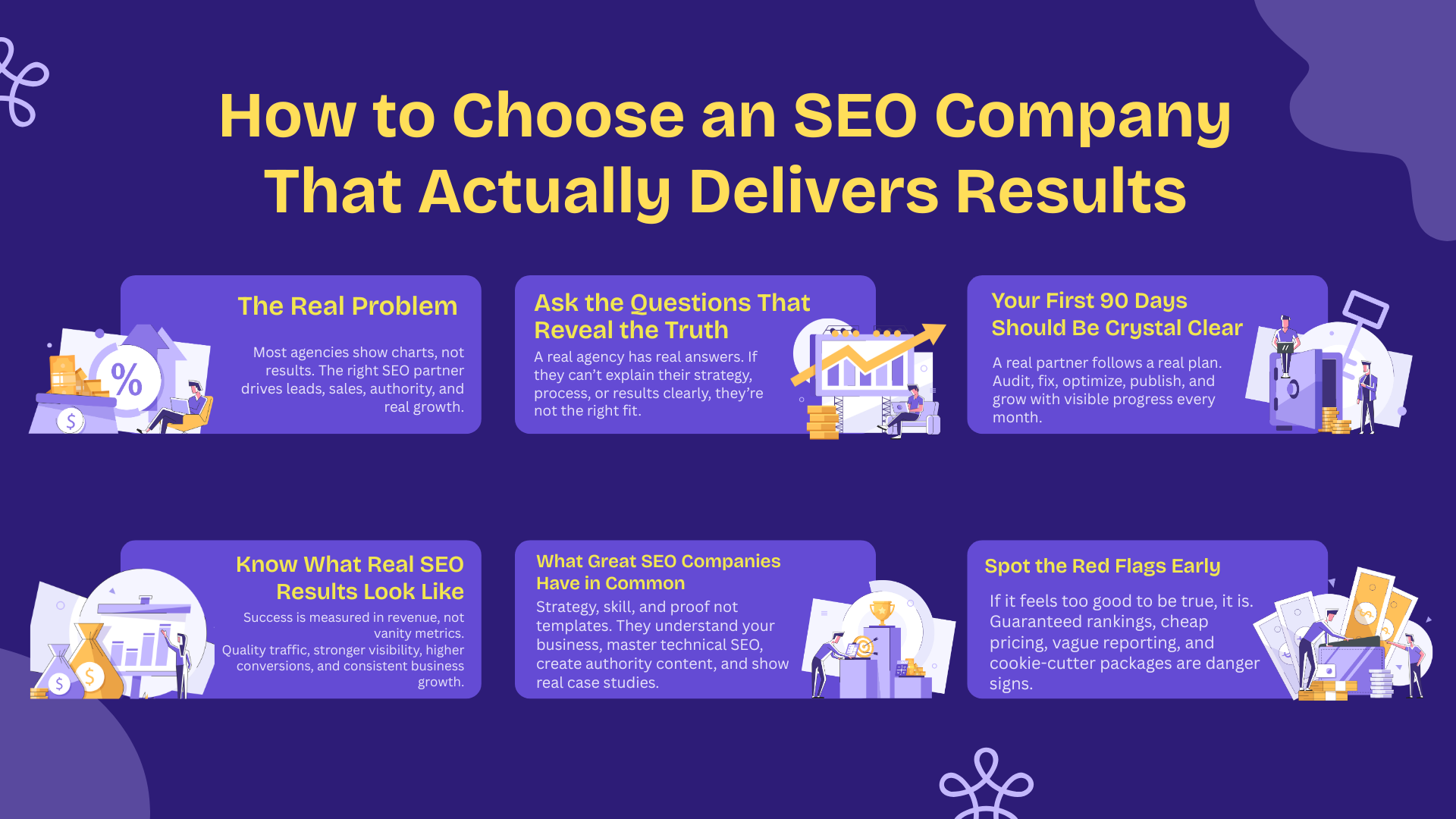
Choosing an SEO company is one of the most important decisions a business can make today. The right partner can transform your website into a revenue-generating engine. The wrong one can drain your budget, waste your time, and leave you confused about why your rankings aren’t improving.
Many business owners, perhaps including you, have already lived through the disappointment. You pay an agency for months, receive reports full of charts and keyword impressions, yet your leads, calls, or online sales barely change. When you ask what’s happening, you hear, “SEO takes time, trust the process.”
This guide is designed to eliminate that frustration completely. It gives you a practical, unfiltered, deeply detailed framework to evaluate any SEO company and choose one that actually delivers meaningful results, not just activity.
If you’re looking for a straightforward, honest breakdown that goes beyond generic tips, you’re in the right place.
Important Questions to Ask Before Hiring an SEO Company
To cut through selling points and get to the truth, ask these questions during your consultation:
- What will the first 90 days of working together look like?
- Who will be doing the actual work?
- How do you build your keyword strategy?
- What is your approach to technical SEO?
- How do you ensure your content meets quality and expertise standards?
- What are your link-building methods?
- What tools do you use for tracking and reporting?
- How do you measure success beyond traffic or rankings?
- Can I see examples of long-term results?
- How do you stay updated on algorithm changes?
The right SEO company will answer confidently, logically, and transparently. The wrong one will rehearse buzzwords, dodge specifics, or redirect your questions.
Understanding What Real SEO Results Actually Look Like
Before you can pick the right SEO company, you need to know what real results actually look like. This is where most businesses get misled. Agencies love to flash numbers that look impressive on paper but mean almost nothing in the real world. Impressions go up, a few low-value keywords climb, an automated audit spits out a “site health score,” or your traffic bumps up just enough to look busy, but none of it turns into revenue.
Those are vanity metrics. They create the illusion of progress without delivering real business growth. And if an agency is leaning on them, it’s a sign they’re measuring success in the wrong places.
Real SEO results look very different. They include measurable improvements in the areas that matter most to your business:
- Higher-quality organic traffic
- More inquiries, leads, or bookings
- Increased online sales
- Lower acquisition costs
- Improved conversion rates
- Strong, sustainable keyword visibility
- A more trustworthy and authoritative online presence
- A better-performing website across UX, content, and speed
When SEO is executed properly, your business feels the difference. Organic traffic becomes one of your highest-performing channels. The quality of your leads improves. Your content begins to attract attention from industry publications. Your brand earns authority. Your competitors start to lose ground.
This is real SEO. Anything less is not worth your investment.
7 Pillars of an SEO Company That Can Actually Deliver
Exceptional SEO companies share seven traits. Think of these as the pillars of a truly competent agency qualities that consistently separate top firms from those offering cookie-cutter services.
Failing to evaluate these pillars is often why businesses end up partnering with the wrong agency.
Deep Understanding of Your Business and Industry
Effective SEO doesn’t start with keywords, it starts with understanding the heartbeat of your business.
A great SEO partner wants to know what actually drives your revenue, who your best customers are, how your industry behaves, and where your competitors are gaining ground. They’re curious about your busy seasons, your slow seasons, your margins, your growth goals, and the real obstacles standing between you and page-one visibility.
This kind of agency doesn’t hand you a prepackaged “SEO bundle.” They shape a strategy around your world, not someone else’s template. Every decision they make ties back to what matters most for your business.
So if an SEO company doesn’t ask real questions, or worse, jumps straight into selling you a package, you’re not dealing with a strategist. You’re dealing with someone following a checklist. And checklists don’t win in competitive search results.
Technical SEO Expertise
Technical SEO is the backbone of organic performance. A beautifully written blog or perfectly optimized page means nothing if search engines struggle to crawl, understand, or index your site.This is why technical expertise is non-negotiable.
A competent SEO company should be able to audit and fix issues related to:
- Website architecture
- Site performance and speed
- Core Web Vitals
- Mobile responsiveness
- Internal linking structure
- Structured data and schema
- Duplicate content
- Canonicalization
- XML sitemaps
- JavaScript rendering issues
- URL structure
- Crawl budget management
- Redirect chains
- Broken pages and links
A real technical audit is thorough and human-led, not a simple automated report. If an agency doesn’t show serious technical capability, they won’t be able to produce long-term ranking improvements.
Content That Satisfies Search Intent and Builds Authority
Content is at the heart of modern SEO, but not the kind of content most agencies churn out. Far too many firms hand your blog strategy to the lowest-cost writers they can find or lean entirely on AI to produce endless paragraphs of bland, recycled material. What you get is predictable: thin content, generic ideas, and articles that feel like they were copied and pasted from five other websites. They don’t rank, they don’t build trust, and they certainly don’t drive conversions.
High-performing SEO content looks nothing like that. It has weight. Depth. Originality. It speaks directly to the questions your audience is actually asking. It carries your brand’s expertise in every sentence. It earns attention instead of begging for it.
Great SEO content doesn’t simply fill a page, it pulls readers in, keeps them engaged, and positions your business as the authority in the room.
To do that, high-quality SEO content must:
- Demonstrate real expertise, lived experience, and trustworthiness
- Match the exact search intent behind each query
- Be grounded in research, data, and industry knowledge
- Undergo thoughtful editing for accuracy and clarity
- Fit into a broader content ecosystem, not isolated, random blogs
- Speak to a specific moment in the buyer’s journey
- Guide readers smoothly toward conversion without sounding pushy
When an SEO company overlooks the importance of well-crafted, authoritative content, they’re not just missing a piece of the puzzle, they’re missing one of the biggest ranking drivers in today’s search landscape. Smart SEO isn’t about publishing more content. It’s about publishing content that truly matters.
Ethical and Effective Link Building
Links remain one of the strongest ranking signals on Google, but how they’re acquired matters.
Low-quality SEO companies purchase backlinks from spam sites, private blog networks, or link farms. These links may offer short-term gains but can cause long-term penalties.
Real link building relies on:
- Industry publications
- Digital PR
- High-value guest contributions
- Interviews and podcasts
- Original reports or research
- Linkable content assets
- Relationship-driven outreach
Quality links take time, creativity, and strategy. If a company promises hundreds of backlinks quickly, that’s a sign they’re using risky shortcuts.
Clear, Transparent Reporting and Communication
You should always know what your SEO company is doing and how it impacts your business.
The best agencies provide:
- Monthly strategy calls
- Transparent dashboards
- Keyword movement tied to business goals
- Lead and revenue tracking
- Competitor insights
- Conversion analysis
- Clear explanations not technical jargon
Poor communication is one of the biggest reasons business owners lose trust in SEO. Great communication restores that trust and makes SEO feel empowering rather than confusing.
A Proven Track Record
Any SEO company can talk. Very few can show proof.
Before choosing one, review their:
- Case studies
- Long-term client relationships
- Industry-specific results
- Before-and-after snapshots
- Real testimonials
- Examples of technical work
- Examples of content strategy
- References you can contact
A company with no proof should not handle your SEO. A results-driven partner will gladly show you past successes, because they have nothing to hide.
A Scalable, Future-Proof Approach
Search engines evolve weekly. An SEO company’s approach must evolve with them.
Future-focused SEO includes:
- Optimization for AI-powered search
- Strengthening E-E-A-T signals
- Building topic authority
- UX-centered optimization
- Regular content refreshes
- Ongoing technical refinement
- Expansion into new keyword clusters
- Adaptation to new SERP features
- Multi-format content strategies, including video and structured answers
You want a partner who keeps up with algorithm changes and proactively updates your strategy. Avoid agencies that rely on outdated tactics or dismiss new trends.
Red Flags to Watch for When Choosing an SEO Company
To protect yourself from disappointment, here are clear red flags to avoid. If you see even one of these, proceed with caution. If you see several, walk away.
- Guaranteed rankings (no one controls Google)
- Extremely low pricing
- Packages that look identical for every client
- No discussion of technical SEO
- Overemphasis on backlinks
- Outsourced content writing with no editorial quality control
- Vague or confusing reporting
- No discovery process
- No case studies or proof
- Lack of transparency about their process
These issues almost always signal underperformance.
Matching Your SEO Partner to Your Business Type
Different types of businesses require very different SEO strategies. Knowing which category you fall into helps you choose a company that understands your needs.
Local Businesses (dentists, plumbers, restaurants, law firms)
Local SEO is essential. You need:
- Google Business Profile optimization
- NAP consistency
- Local reviews
- Localized content
- Location landing pages
- Map pack ranking strategies
eCommerce Brands
Your SEO partner needs to excel in:
- Product page optimization
- Collection structure
- Schema
- Conversion rate optimization
- Technical enhancements
- Internal linking at scale
Service Businesses and Consultants
You need:
- High-converting landing pages
- Search-intent content
- Local or national strategy
- Reputation management
- Funnel-aligned content ecosystems
SaaS Companies
You require:
- Product-led SEO
- Feature + comparison pages
- Pain-point content
- Demo-intent optimization
- Topical authority building
Enterprise and Multi-Location Businesses
You need:
- Advanced technical infrastructure
- Governance and approvals
- Scalable content systems
- Multi-location architecture
- International SEO strategies
The best SEO company is one that already understands the nuances of your industry.
Pricing, Contracts, and Timelines: What You Should Expect
SEO is an investment, but you’re not paying for “tasks.” You’re paying for expertise, strategic thinking, senior-level execution, and long-term growth that compounds over time. The right agency isn’t selling deliverables; they’re engineering outcomes.
Typical Pricing Ranges
SEO pricing varies based on complexity, competitiveness, and the depth of strategy required:
- Small businesses: $1,500–$4,000/month
- Mid-sized companies: $4,000–$10,000/month
- Enterprise or multi-location brands: $10,000–$50,000+/month
If the price seems unusually low, assume the work is automated, outsourced, or based on cookie-cutter templates. High-quality SEO requires real talent, and real talent isn’t cheap.
Contracts
SEO requires commitment, but not blind commitment. Avoid long-term agreements longer than 6–12 months unless:
- The agency has already proven results
- The project scope genuinely requires a long runway
- The level of trust and transparency is unquestionable
Most businesses are best served with month-to-month or 3-month cycles, long enough for strategy, short enough for accountability.
Timelines
SEO is not overnight marketing, but neither should it feel like wandering in the dark. Every phase should produce clear, measurable movement.
- 0–3 months: Technical fixes, clean-up, foundational optimization
- 3–6 months: Noticeable improvements in visibility, rankings, and site health
- 6–12 months: Breakthrough movement on competitive keywords
- 12–24 months: Compounding authority, consistent lead flow, and scalable growth
SEO takes time, but real SEO always shows momentum. You should never feel stuck, stalled, or guessing. A strong agency makes progress visible, every single month.
What Your First 90 Days Should Look Like
The first three months set the tone for your entire engagement. A strong SEO partner uses this period to build momentum, fix the issues holding your website back, and lay the foundation for long-term growth. A weak partner will deliver vague updates, slow progress, and no real strategy. Here’s what the first 90 days should look like with an agency that knows what they’re doing.
Month 1: Setting Up the Foundation
The first month is all about uncovering what’s preventing your website from ranking and preparing a data-backed strategy. Nothing effective happens until the groundwork is solid.
A strong agency will complete:
Technical Audit
A deep, manual review of your site’s health, speed, structure, crawlability, indexation, broken pages, mobile experience, schema, and more. This shows exactly where Google is struggling to understand your website.
Keyword and Intent Mapping
Researching the right keywords those tied to revenue, not vanity, and matching them to search intent. This ensures every page targets meaningful opportunities, not random traffic.
Competitor Gap Analysis
Studying who currently dominates your search space and identifying what they’re doing better. This reveals your opportunities, content gaps, and the authority you need to build.
Analytics & Tracking Setup
Proper GA4, Google Search Console, and conversion tracking. Without accurate data, no SEO strategy can succeed.
Crawl Diagnostics
Running crawl simulations to uncover crawling issues, duplicate content, indexation errors, and structural weaknesses invisible to the human eye.
UX Evaluation
Checking how users behave on your site where they drop off, what slows them down, and what prevents them from converting.
Content & Architecture Strategy
Planning how your site should be structured, which content pillars to build, and how your pages should connect internally for maximum search visibility.
Outcome of Month 1:
You walk away with a clear, documented SEO roadmap that breaks down what needs fixing, what needs building, and what needs prioritizing. If your agency can’t give you that by the end of the first month, they’re not operating strategically.
Month 2: Fixing Issues and Building Structure
This is where execution starts. A competent SEO company turns the findings from Month 1 into tangible improvements that remove ranking barriers and strengthen your website’s foundation.
During this phase, your agency should:
Execute Technical Fixes
Repair crawling issues, broken pages, redirect loops, duplicate content, slow loading times, and any structural issues flagged earlier.
Improve Site Speed and Core Web Vitals
Enhance server response times, image optimization, script handling, caching, and mobile performance critical for modern rankings.
Rewrite Key Pages
Re-optimize essential money pages (services, product pages, core landing pages) so search engines clearly understand their purpose.
Update Metadata & Internal Linking
Improve titles, descriptions, headers, and interlinking to strengthen page authority and relevance.
Publish Foundational Content
Launch your most important content assets guides, service pages, category pages, or FAQs that fill your biggest keyword gaps.
Optimize Landing Pages for Conversions
Make structural, UX, or copy adjustments that help visitors take action form submissions, calls, purchases, or bookings.
Strengthen Site Architecture
Refine your URL structure, content clusters, navigation, and internal link hierarchy so your entire site becomes more crawl-friendly and authoritative.
Outcome of Month 2:
Your website becomes faster, cleaner, technically sound, and strategically optimized. This is where early ranking shifts and improved visibility begin.
Month 3: Accelerating Growth
Month 3 is where momentum starts to build. Now that the foundation is fixed, your agency can focus on expanding your visibility, increasing topical authority, and generating early compounding gains.
Your agency should now focus on:
Publishing Optimized Content Clusters
Creating content hubs and interlinked articles around core themes builds topical authority and helps you dominate entire search categories.
Launching Ethical Link-Building
Pitching digital PR, securing high-quality backlinks, earning mentions in industry publications, and creating content worth linking to. Authority begins to grow here.
Developing Authority-Driven Assets
These may include expert guides, original research, infographics, tools, or resources designed to attract links and build brand credibility.
Expanding Keyword Coverage
Targeting mid- and long-tail opportunities that bring qualified traffic and strengthen your presence in your niche.
Monitoring and Interpreting Ranking Improvements
Identifying which optimizations are working and which need more attention, not just reporting numbers, but explaining the “why.”
Adjusting Strategy Based on Real Data
Refining priorities based on performance, new opportunities, seasonal shifts, and algorithm updates.
Improving Conversion Pathways
Fine-tuning messaging, layout, CTAs, UX flows, and page structure to ensure the new traffic converts into leads or sales.
Outcome of Month 3:
You should see measurable momentum, better rankings, clearer visibility, stronger authority, and early signs of compounding growth.
If an SEO company can’t clearly explain what happens in these 90 days, they’re not ready.
A capable SEO partner knows exactly what Month 1, Month 2, and Month 3 look like because they follow a proven system not guesswork. Every step ties into a long-term growth plan, and nothing feels random or reactive.
If the agency you’re evaluating cannot outline their first 90 days with clarity, confidence, and specifics, that’s a sign they aren’t prepared to manage your SEO at the level your business deserves.
Final Checklist: How to Make Your Decision with Confidence
Before you lock in an SEO partner, run them through this reality check. The difference between a growth-driving agency and a budget-wasting one becomes obvious when you know what to look for.
What a High-Performing SEO Company Looks Like
They will:
• Dig deep into your business model, goals, margins, and customers
• Build a strategy that’s tailored, not templated
• Show real proof: case studies, data, wins, and long-term client success
• Tackle technical SEO with confidence, not hesitation
• Create polished, authoritative, search-intent-aligned content
• Provide transparent reporting you don’t need a translator for
• Communicate consistently and proactively
• Tie every optimization back to real business impact not vanity metrics
What a Weak SEO Company Looks Like
They tend to:
• Promise guaranteed rankings or overnight success
• Push low-cost, one-size-fits-all “packages”
• Skip technical SEO entirely or pretend it’s “not important”
• Outsource all work to the cheapest freelancers
• Publish thin, generic, keyword-stuffed content
• Build questionable links that do more harm than good
• Go quiet for weeks at a time
• Send reports with no context, no explanation, and no accountability
When you compare agencies through this lens, the right partner becomes incredibly easy to identify. The leaders stand out. The pretenders do too. And your decision becomes a whole lot clearer.
Conclusion: The Right SEO Partner Transforms Your Business
SEO, when done well, is one of the few marketing investments that keeps paying you back long after the work is done. It builds authority, fuels consistent visibility, attracts higher-quality customers, and creates a growth engine that compounds over time. But that only happens when you’re working with the right partner.
Choosing an SEO company isn’t about hiring someone to publish blogs or sprinkle keywords across your site. It’s about trusting a team that understands how your business actually works, communicates with clarity, makes strategic decisions backed by data, and takes responsibility for delivering meaningful outcomes not just activity.
- When you choose wisely, SEO stops feeling like a gamble.
- It becomes a predictable pipeline.
- It becomes a competitive advantage.
- It becomes credibility, trust, and growth rolled into one.
So take the time to evaluate your options carefully.
Look beyond polished sales pitches and focus on depth, process, proof, and alignment.
The right SEO partner won’t just improve your rankings, they’ll elevate your entire business.
Choose the team that thinks the way you think, cares the way you care, and builds a strategy that’s truly your own. That’s when SEO becomes unstoppable.

Gourav Jaswal is a digital marketing strategist and SEO expert with over 14+ years of experience in search engine optimization, local SEO, PPC advertising, and online business growth. As the founder of SEO & Web Service, he has helped businesses improve their online visibility, generate qualified leads, and achieve sustainable growth through data-driven digital marketing strategies. Over the years, he has worked with 90% USA-based clients across a wide range of industries, developing and executing successful SEO campaigns for multiple niches with proven track records. Gourav specializes in SEO audits, Google Ads, content marketing, technical SEO, local SEO, and website optimization, helping businesses strengthen their online presence, increase organic traffic, and drive measurable business results.