If you run a business that goes to the customer, think plumbers, electricians, contractors, cleaning services, mobile auto repair, or even personal training you’re a Service-Area Business (SAB). Unlike a local coffee shop or gym, you don’t rely on foot traffic; your entire revenue stream depends on your visibility in the digital space. For you, the Google Business Profile (GBP) isn’t just a listing; it’s your primary lead engine. It’s the digital truck that rolls out every time someone searches for your service with the crucial, high-intent phrase: “[Service] near me.” Understanding how to improve google my business ranking for Service-Area Businesses is the key to getting in front of these ready-to-hire customers.
But here’s the tea: Google’s ranking algorithm has a major crush on businesses with a physical storefront. Proximity, or the distance between the user and the business, is one of the three core ranking factors for local search. If you don’t have a visible pin on the map, the kind that screams “We are right here!”, you’re starting the local race with a handicap. Your competition often includes hybrid businesses that do have a retail address, putting you at a distinct disadvantage in the coveted three-pack of Google Maps.
This guide is designed to close that gap. This is not a guide filled with generic, fluffy advice you can find anywhere else. This is a deep dive into the specific, structural strategies that directly address the SAB challenge. We’re providing a filler-free, highly technical breakdown of the pillars you must master to achieve top rankings, even without a visible address. Since you can’t win on Distance, you must over-index and consistently outperform your competitors on Relevance and Prominence. It’s all about providing Google with hyper-specific, trustworthy data that proves you are the most legitimate, popular, and relevant service provider in the area they need you.
Forget the low-effort tactics. We’re getting into the structure, the compliance specifics, and the advanced optimization moves that will make your service-area business stand out, drive more calls, and ultimately, secure your digital territory.
The Core Foundation (Address vs. SAB Setup)
The Non-Negotiable Setup and Compliance
The first, and most crucial, step in winning the SAB ranking game is correctly defining your business for Google. This isn’t about gaming the system; it’s about absolute compliance with Google’s guidelines and crystal-clear clarity for the algorithm. Missteps here, from using the wrong address type to improperly setting your service boundary, can lead to a soft or hard profile suspension, which is an immediate game over for your local visibility.
The Critical Address Decision: Compliance First
Before you optimize anything, you must establish your true nature as an SAB according to Google’s rules:
- The Pure SAB Mandate: If you do not serve customers at your physical business location (e.g., your home office, a storage unit, or a non-customer-facing warehouse), you must hide your address on your GBP. Listing a residential or virtual office address where no staff is present during your stated hours is a direct violation of Google’s guidelines. This is the single biggest trigger for competitor spam reports and profile suspension. The rule is simple: if you don’t interact with customers face-to-face at the location, don’t show the address.
- The Hybrid Exception: If you do serve customers at your physical location and travel to service areas (e.g., a carpet cleaner with a shop where clients can drop off rugs, or a consultant with an office for appointments), you are a Hybrid Business. In this case, you must display the physical address and define your service areas. This dual presence grants you the strongest possible ranking advantage because you satisfy both proximity and service area criteria.
- Actionable Setup: For a pure SAB, make sure you enter your legal physical address (for verification purposes, you need a real mailing address), but then navigate to the profile settings and ensure the address display is toggled off. Only your Service Areas should be visible to the public.
Defining Your Service Area Boundary (SAB’s Digital Pin)
Since you don’t have a static pin, your defined service area is the only proximity signal Google uses for you. It must be precise and justifiable.
- Specificity is the Key: Google allows you to define your service area using cities, postal codes, or specific regions/counties. Do not use the obsolete radius-based setting (e.g., “15 miles from the office”). Specify the exact names of the cities you serve (e.g., “Dallas, TX,” “Plano, TX,” “Frisco, TX”).
- The 20-Area Limit: You are allowed to list up to 20 service areas. Be judicious and strategic. Focus only on the areas you actually serve and can reach within a reasonable and professional timeframe, typically under a two-hour driving radius from your base of operations. Exceeding this limit or listing areas you don’t genuinely cover is a clear violation and dilutes your ranking power in your core territory.
- NAP Consistency is Non-Negotiable: This is a foundational SEO tenet. Ensure your Business Name, Address (or the fact that the address is hidden), and Phone number are identically formatted across every online citation, directory, and your official website. Even minor variations (e.g., “ABC Plumbing Co.” vs. “ABC Plumbing Company,” or “St.” vs. “Street”) can confuse Google’s algorithm, fragment your authority signals, and dilute your ranking power.
Relevance Mastery (Categories and Keywords)
Optimizing Profile Text for Search Intent
Relevance is how well your profile aligns with a user’s search query. It is a critical factor for all businesses, but for SABs, which inherently lack proximity signals, you must over-index on relevance to tell Google exactly what you do and where you do it, compensating for the lack of physical presence.
Strategic Category Selection: The Decisive Signal
Your category selection is arguably the strongest keyword-related ranking factor on your entire profile.
- The Primary Category: This is the single most important decision. It must be the most accurate, core function of your business (e.g., “Plumber,” not “General Contractor” if you mostly do plumbing). Choose one that Google specifically lists. This tells Google which Local Pack searches you are eligible for.
- The Secondary Categories: Use up to nine secondary categories to capture niche services and highly specific searches (e.g., “Water Heater Supplier,” “Drainage Service,” “Emergency Plumber” for a primary “Plumber”). Use all applicable slots. This expands your relevance net. Avoid keyword stuffing in categories. Only choose categories that genuinely reflect the services you offer and are eligible for. If you are a ‘Mobile Mechanic,’ don’t list ‘Auto Repair Shop’ if you have no physical shop, as this can mislead Google.
Description and Services Optimization: Keyword Depth
This is where you weave your service and location keywords naturally into your profile’s narrative.
- The Description: Use the Full 750 Characters: Don’t waste this space. Front-load the description with your primary service and the key cities/areas you serve (e.g., “The leading emergency plumber serving all of Dallas, Plano, and Collin County. We specialize in 24-hour service, water heater repair, and burst pipe remediation. We are fully licensed and insured.”).
- Focus on Intent Keywords: Skip vague language. Use high-intent, long-tail keywords that customers actually search for in a crisis (e.g., “24-hour emergency roof repair in [City]”, “affordable boiler service”, “local kitchen remodeling expert”).
- Detailed Services List (The Underutilized Weapon): The Services section within your GBP dashboard is often neglected, but it acts as a powerful keyword repository. List every specific service you offer (even minor ones) and provide a detailed, unique, keyword-rich description for each one. Example: instead of just ‘HVAC,’ list ‘HVAC Installation,’ ‘HVAC Repair,’ ‘Air Conditioner Maintenance,’ with 100-300 word descriptions. This significantly expands your relevance map for highly specific searches.
Leveraging the Q&A Section
- Self-Seeding for Keywords: Actively post and answer your own Frequently Asked Questions (FAQs). This is a completely compliant and clean way to inject relevant local and service keywords into your profile content, influencing search results.
- Common SAB Q&As: Focus on questions that address your service area (“Do you serve the Lakewood neighborhood in Dallas?”), your pricing structure, scheduling, and emergency availability. This preempts customer doubts and adds significant keyword depth. Example question: “Are your electricians available for emergency wiring repair in the Frisco area?”
Prominence & Authority (Reviews and Engagement)
Building Trust and Digital Reputation
Prominence is Google’s measure of how well-known, trusted, and authoritative your business is, both online and off. Since SABs lack a physical location to generate organic prominence signals, this pillar is the closest and most important proxy to the storefront advantage. You need to look legitimate, popular, and trustworthy.
The Review Engine (Quantity, Quality, Frequency)
- Reviews are the Top Signal: Reviews are arguably the single most influential ranking signal that you, as an SAB, can control. Google values the quantity (the total number of reviews), the average rating (quality), and most critically, the freshness (frequency) of reviews. A large number of recent, high-quality reviews strongly indicates a healthy, active business.
- Systematic Ask: Implement a systematic, high-tech process to ask every happy customer for a review immediately after the job is complete. Use simple, automated tools to send direct GBP review links via text or email. High frequency of recent, positive reviews is paramount to signaling popularity to Google.
- Respond to Everything (The SEO Value): Respond to all reviews, positive and negative, with a professional, personalized tone. This shows engagement and care. Crucially, in your positive replies, subtly and naturally inject your service keywords and the city/neighborhood where the work was performed (e.g., “So glad we could fix your kitchen sink so quickly for you in the Sunset Hills neighborhood! We pride ourselves on fast emergency plumbing services in that area.”). This confirms your real-world service area to Google and injects hyper-local terms into your profile’s content index.
Active GBP Management (Posts and Media)
- Post Weekly: Your profile should never look dormant. Use Google Posts to maintain high activity and freshness. Post about special offers, recent job photos, team spotlights, or seasonal tips (e.g., “Winterizing your pipes in Plano, TX is key right now!”). Regular, consistent activity is a strong engagement signal that proves your business is operational and relevant.
- High-Quality, Geo-Tagged Photos: Upload real, high-quality photos and videos of your team, your branded vehicles (crucial for SAB visual proof), and actual job sites (before-and-after works great). For advanced optimization, use a tool to geo-tag your images with the specific city/location data of the job site before uploading them. This is a subtle, advanced way to confirm your physical presence in your service areas to Google’s image recognition algorithms.
- Monitor Insights: Regularly check your GBP Insights for data on search queries (what people typed to find you), profile views, and customer actions (calls, website clicks). Use the search query data to refine your category and service list keywords. If people are finding you for a term you hadn’t focused on, integrate it strategically.
Website and On-Page Synergy (Hyperlocal Landing Pages)
(H2 – Integrating Website Content for Service Area Coverage)
Your website is the foundational support system for your GBP ranking. Google looks at the authority, content, and structure of the linked website to gauge the overall credibility of your business profile. For SABs, the website must do the heavy lifting of proving your legitimate, granular service area coverage.
The Localized Content Strategy: The Authority Move
- Service Area Landing Pages (SALPs): This is the most effective way to prove SAB coverage. Create dedicated, robust, and optimized landing pages for your most important service areas (e.g., /hvac-repair-dallas-tx/, /plumber-springfield-ma/).
- Content Must Be Unique and High-Quality: Do not simply duplicate the same 300 words and swap the city name. Each page must feature unique text (minimum 500-700 words), local testimonials specific to that area, geo-relevant imagery, mentions of local landmarks or neighborhoods within that service area, and a local phone number if possible.
- Keyword Placement: The city/neighborhood name must be naturally included in the page title, meta description, H1 heading, and the first paragraph.
- Internal Linking: Ensure these SALPs are well-linked from your main services pages and geographically related pages.
- Link Back: Crucially, link back to your GBP profile or embed a Google Map snippet showing your service area boundaries on these local pages.
NAP Consistency on the Website
- Footer/Header Verification: Ensure your perfectly consistent NAP (Name, Address, Phone number, or just Name and Phone for SABs) is clearly visible and crawlable text (not just an image) in the footer or contact page of your website. This is the ultimate self-validation signal.
- Tracking Numbers Caution: While tracking phone numbers are useful for analytics, if you use one on your GBP, ensure your main, canonical local phone number is prominently displayed as the primary contact on your website. NAP consistency dictates that the phone number Google finds most often should be the same.
Technical SEO for Local Context
- Local Business Schema Markup: Implement Local Business Schema Markup (structured data) on your website’s footer and contact pages. This code explicitly tells search engines your business type, official operating area, phone number, and official URL in a language they perfectly understand. The more explicit you are, the more trustworthy you become.
- Geo-Targeting in Search Console: While modern SEO relies less on this, it’s a critical foundational check. Verify that you have properly set your target country/region in your Google Search Console settings. This ensures Google understands your broad geographic focus.
Off-Page Validation (Citations and Authority)
Building External Trust and Local Link Signals
Google operates on trust. Since your SAB profile is largely invisible on the map, Google needs external validation to trust your claim of being the top provider in your service area. Local citations and high-quality backlinks act as the digital “votes of confidence” that significantly boost your Prominence score.
Consistent Citation Building (The Digital Fingerprint)
- Directory Cleanup: This is tedious but mandatory. Conduct a deep audit of your business listings across major national, local, and industry-specific directories (Yelp, Facebook, BBB, Yellow Pages, industry sites like Angie’s List, HomeAdvisor, etc.). Correct any NAP inconsistencies instantly. Inconsistent citations confuse Google and pull your ranking down.
- The SAB Focus: Prioritize industry-specific and geographically relevant directories. For SABs, directories like your local Chamber of Commerce, city/county business registries, neighborhood groups, and local city directories carry disproportionately more weight for local ranking than general national directories.
- Structured vs. Unstructured: Build both:
- Structured Citations: The standardized profile listings on directories and social platforms.
- Unstructured Citations: Mentions of your business name, address, or phone number in local news articles, blogs, community forum discussions, or other editorial content. These often signal real-world recognition.
Local Link Building (The Authority Vote)
- Quality Local Backlinks: High-authority links pointing from other websites to your website act as a powerful ranking factor for your GBP. Google sees these links as a direct endorsement.
- Strategy Focus: Your link building must have a local angle:
- Sponsor Local Events or Teams: This often results in a high-authority link from the organization’s website.
- Partner with Non-Competing Local Businesses: Trade links or offer reciprocal services (e.g., a painter and a carpenter linking to each other).
- Expert Content: Offer your expertise to local news sites or reputable blogs for an attribution mention (e.g., “Local Plumber Offers Winter Pipe Tips”). Links from locally relevant, high-domain-authority sources are gold and directly reinforce your SAB’s geographic claim.
Conclusion: Securing Your Digital Territory
Final Summary and Call to Action
Ranking a Service-Area Business is a high-effort, high-reward endeavor. You are fundamentally fighting the core “Distance” factor in Google’s algorithm, which means you must achieve exceptional, bulletproof scores in both Relevance and Prominence.
The SAB Masterclass isn’t about one-time fixes; it’s a commitment to continuous, granular, hyper-local optimization:
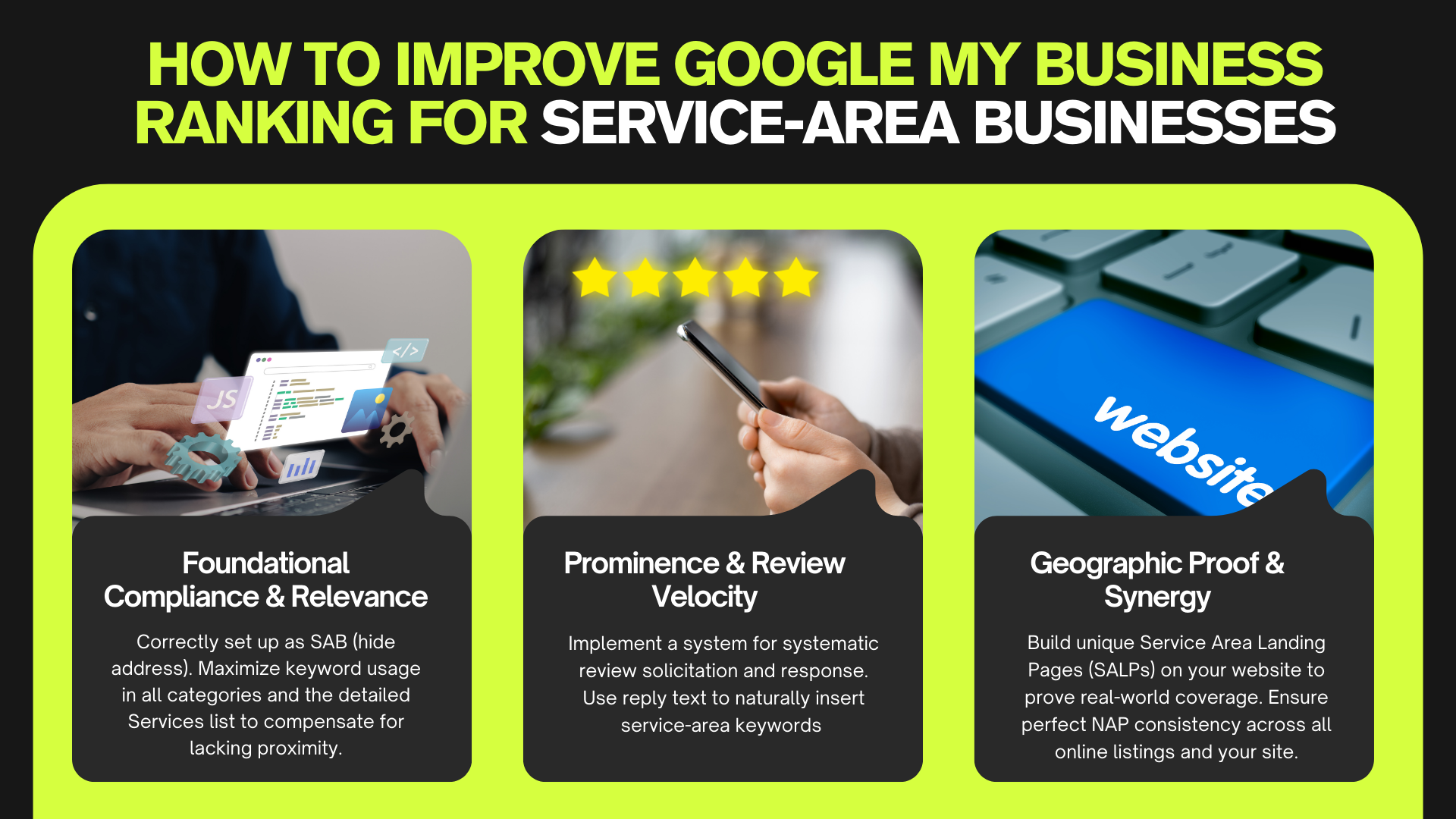
- Pillar 1 (Foundation): Set your profile up correctly, hide your address, and define your service areas conservatively and accurately.
- Pillar 2 (Relevance): Use every category and keyword field (especially the Services list) to tell Google exactly what you do and where you do it.
- Pillar 3 (Prominence): Drive a systematic review engine and use reply responses and GBP Posts to weave local keywords into your profile’s content.
- Pillar 4 (Synergy): Build unique, authoritative Service Area Landing Pages on your website to prove real-world geographic coverage.
- Pillar 5 (Validation): Maintain impeccable NAP consistency across all external directories and aggressively pursue high-quality, local backlinks.
Every piece of information from the geo-tag on a photo of a recent job to the mention of a specific neighborhood in a review reply is a digital breadcrumb that proves to Google and potential customers that you are the legitimate, high-quality, and most relevant service provider in their exact time of need. This disciplined, comprehensive approach is the only way to overcome the SAB handicap and secure your digital territory.
Google My Business Ranking Quick Hits
Addressing Common, Final Questions
Q: Can I list my home address and just hide it?
A: Yes, and for verification purposes, you must use your real, physical business address (where you receive mail and where staff work during stated hours). However, for a pure SAB, you must remove the public display of that address in your GBP settings. Using a PO Box, a shared virtual office, or an address where no staff is present is a clear guideline violation and a risk for suspension.
Q: How many service areas are too many?
A: Google allows up to 20, but the practical limit is determined by your geographic reality. If the furthest area is more than a two-hour drive from your base of operations (or whichever location Google uses to calculate proximity), it’s likely too far and risks diluting your ranking power in your core, high-value areas. Focus on the core territory where you genuinely generate the majority of your business.
Q: Should I use a tracking phone number for my GBP?
A: While tracking numbers are valuable for measuring ad performance, they are a known factor in creating NAP inconsistency, which can harm your ranking. If you must use a unique tracking number on your GBP, ensure your single, canonical, local phone number is also present and prioritized on your website and all major citations. A local number is generally preferred for consistency and local trust.
Q: My competitor is ranking well with a fake address. What gives?
A: That competitor is almost certainly violating Google’s guidelines (a form of Spam). They are likely a pure SAB masquerading as a Hybrid Business. You can file a Redressal Complaint directly to Google to report the violation. While the process can be slow, removing fraudulent, spamming competitors is a vital, ongoing part of local SEO.
Q: How often should I post to my GBP?
A: Aim for at least one Google Post per week to maintain freshness and activity signals. Consistency is far more important than volume. Pair this with a disciplined strategy of review solicitation and response to maintain a profile that Google views as highly active and engaged.
Q: Can reviews from customers outside my service area still help me?
A: Yes, positive reviews from anywhere boost your overall rating and quality score (Prominence). However, reviews that mention your service keywords and the specific cities/neighborhoods in your designated service area carry disproportionately more weight for ranking in those locations. Focus your solicitation efforts on customers within your core territory.

Gourav Jaswal is a digital marketing strategist and SEO expert with over 14+ years of experience in search engine optimization, local SEO, PPC advertising, and online business growth. As the founder of SEO & Web Service, he has helped businesses improve their online visibility, generate qualified leads, and achieve sustainable growth through data-driven digital marketing strategies. Over the years, he has worked with 90% USA-based clients across a wide range of industries, developing and executing successful SEO campaigns for multiple niches with proven track records. Gourav specializes in SEO audits, Google Ads, content marketing, technical SEO, local SEO, and website optimization, helping businesses strengthen their online presence, increase organic traffic, and drive measurable business results.